The Efficiency Partner Method™
Most businesses don't struggle because they lack ideas. They struggle because they have too many, no clear sense of where to start, and not enough time to do everything at once.
When clients come to me, they usually arrive with a long list of operational pain points and a growing sense that something needs to change. The first thing we do is cut through the noise.
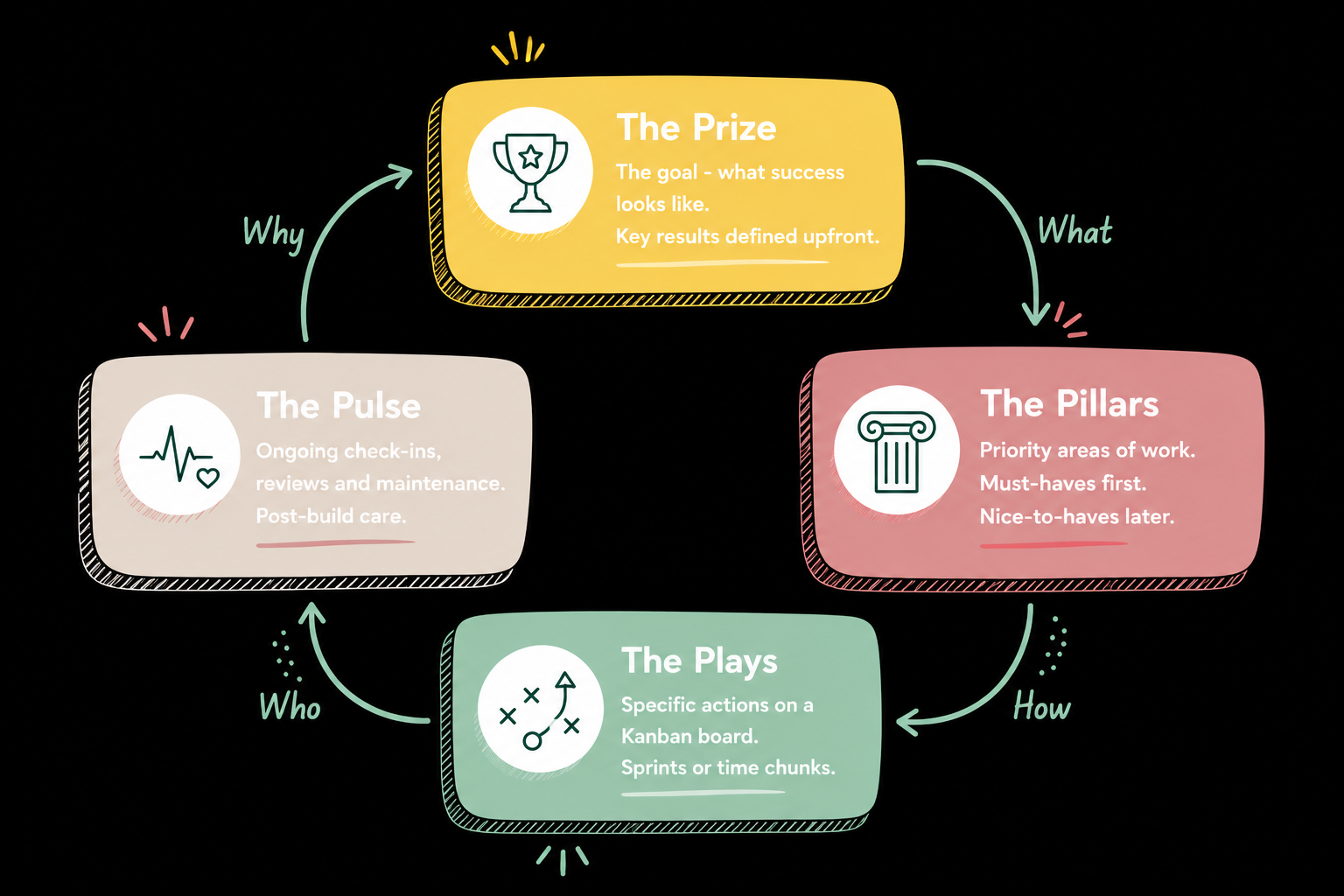
The Efficiency Partner Method™ is how I structure that work. It's a practical, flexible framework built around four stages: The Prize, The Pillars, The Plays, and The Pulse. Together they give every engagement a clear direction, a manageable structure, and a way of working that fits the client rather than a rigid process imposed on them.

The Prize
Where are we going, and what does success look like?
Every engagement starts with clarity on the goal. The Prize is the single most important objective, the thing that, if achieved, makes everything else worthwhile.
In many cases clients arrive already knowing what their Prize is. In others, I send a short series of questions in advance of our first conversation to get them thinking about it before we meet. What is the problem we're really trying to solve? What does good look like when we get there? What are the measurable signs that we've succeeded?
Those success signals become our key results, the markers we'll track throughout the engagement to know whether we're making genuine progress.
Everything else in the method organises itself around The Prize.

The Pillars
What are the big things that need to happen to get us there?
Once we know where we're going, we identify the Pillars: the meaningful areas of work that need to happen to reach The Prize. These aren't tasks. They're the significant shifts that change how the business operates.
Pillars are categorised by priority. Some are essential, the things that have to be in place before anything can go live. Others are important but can follow once the foundations are solid. Others still are useful additions that would be great to have but won't block progress if they wait.
This distinction matters. It means we're always working on what's most important first, and we're honest from the start about what's realistic given the time and resource available. Not every Pillar will get done in every engagement, and that's fine. Knowing which ones matter most means we never lose sight of what's critical.

The Plays
What specifically needs to happen, and who is doing what?
Each Pillar breaks down into Plays: the specific, manageable actions that build toward the Pillar being complete and ready to use.
Plays are where the practical work happens. They're tracked visually, on a Kanban board in whichever tool makes most sense for the client, whether that's ClickUp, Asana, a simple Miro board, or even a well-structured spreadsheet. The right tool is the one the client and their team will actually use, not the most sophisticated option available.
A RACI framework helps here too, making clear who is Responsible, Accountable, Consulted and Informed for each Play, so nothing gets lost in the assumption that someone else is handling it.
How we work through the Plays is flexible. Some clients work well in two-week sprints, with a review at the end of each sprint to assess progress and adjust priorities. Others prefer a time-chunk approach, agreeing a block of hours, working through it, checking in to share what's been done, and agreeing the next block. Both work well. The right approach depends on the nature of the work and how the client likes to operate.
All build work is tested before it's considered done. A Pillar isn't complete until it works in practice, not just in theory.

The Pulse
What happens after the build is done?
The work doesn't end when the project does.
The Pulse is the ongoing rhythm of checks, reviews and maintenance that keeps everything working after the initial build. It's the fortnightly check-in, the six-month review, the feedback loop that catches what's drifted or changed. It's also the documentation: the Miro board with everything mapped out, the URLs linked, the decisions recorded, so that when something needs updating six months or a year later, there's a clear record of how it was built and why.
Good operational systems need ongoing attention. Teams change, businesses evolve, tools update. The Pulse ensures that the work we've done together stays relevant, gets used properly, and can be maintained without needing to start from scratch every time something needs tweaking.
Why it works
The Efficiency Partner Method isn't a rigid process. It's a framework that adapts to what each client actually needs.
Some engagements move quickly through all four stages. Others spend longer in the Pillars phase, working through complex prioritisation before any Plays begin. Some clients want to be deeply involved throughout. Others prefer to be briefed at key points and trust the work to happen in between.
What stays constant is the structure: a clear goal, a prioritised plan, visible progress, and a way of maintaining what's been built.
The result is a business that knows where it's going, what it needs to do to get there, and exactly what it's working on right now.
Want to find out how The Efficiency Partner Method could work for your business or more on how it works?