Introducing The Efficiency Partner Method™: project management made simple
I have spent a significant chunk of my career studying project management.
PRINCE2 Foundation. Then Practitioner. Then Agile Practitioner. Then the PMP, which is one of the most rigorous project management qualifications in the world. Then Extraordinary PM Mastery, a brilliant course that sits outside the traditional certification track and focuses on the human and leadership side of project management in a way the others don't quite reach. Then Certified ScrumMaster. Months and months of study, across multiple frameworks, methodologies and approaches to getting complex work done.
And what I discovered, after all of that, is that most small businesses don't need any of it.
Not because project management doesn't matter. It absolutely does. But because the frameworks designed for large organisations, government programmes and enterprise software delivery are often so complex, so process-heavy, and so reliant on dedicated project management infrastructure that they become a barrier rather than a help for smaller businesses trying to get things done.
What small businesses need is the essence of good project management, without the overhead. The thinking behind the frameworks, stripped back to what actually works in practice.
That's what The Efficiency Partner Method™ is.
Where it comes from
Every element of The Efficiency Partner Method draws on something I learned through years of formal study and hands-on practice.
The focus on a single clear objective comes from my PMP training, where one of the foundational principles is that a project without a clear, agreed goal is already in trouble. Scope creep, misaligned expectations, wasted effort. Almost all of it traces back to not being clear enough at the start about what you're actually trying to achieve.
The prioritisation of work into must-haves, should-haves and nice-to-haves comes from agile and PRINCE2, both of which treat prioritisation not as a nice idea but as a discipline. Knowing what's critical versus what can wait is one of the most important skills in project management, and one of the most commonly skipped in small businesses that are trying to do everything at once.
The prioritisation of work into must-haves, should-haves and nice-to-haves comes from agile and PRINCE2, both of which treat prioritisation not as a nice idea but as a discipline. Knowing what's critical versus what can wait is one of the most important skills in project management, and one of the most commonly skipped in small businesses that are trying to do everything at once.
The Kanban board and sprint structure comes directly from my ScrumMaster training. Sprints give work a rhythm. Kanban boards make progress visible. Together they create momentum and accountability without requiring a full-time project manager to maintain them.
One course that sits outside the traditional certification track and deserves a special mention is Extraordinary PM Mastery. Where most PM qualifications focus heavily on process, tools and frameworks, this one goes deeper into the leadership, communication and human elements of project management, the stuff that actually determines whether a project succeeds or fails. It influenced how I think about the who and why elements of The Efficiency Partner Method more than any other course I took.
And running through all of it is something I brought from my years at Herrmann International, working with HBDI® and Whole Brain® Thinking.
The Whole Brain® Thinking connection
Whole Brain® Thinking is a framework developed by Herrmann International that maps how people think across four quadrants. Simplified, those quadrants cover: the analytical (what: facts, data, logic), the practical (how: processes, timelines, execution), the relational (who: people, communication, culture), and the experimental (why: big picture, vision, purpose).
Most people have preferences across these quadrants, and most traditional project management methodologies are heavily weighted toward the analytical and practical. They're full of what and how, and light on who and why.
But in my experience, it's the who and the why that determine whether a project actually succeeds.
You can have the most beautifully organised project plan in the world. If the people involved don't understand why the work matters, or don't feel considered in how it's designed, adoption suffers. Systems get built and abandoned. Processes get documented and ignored.
The Efficiency Partner Method is designed to address all four quadrants, not just two of them.
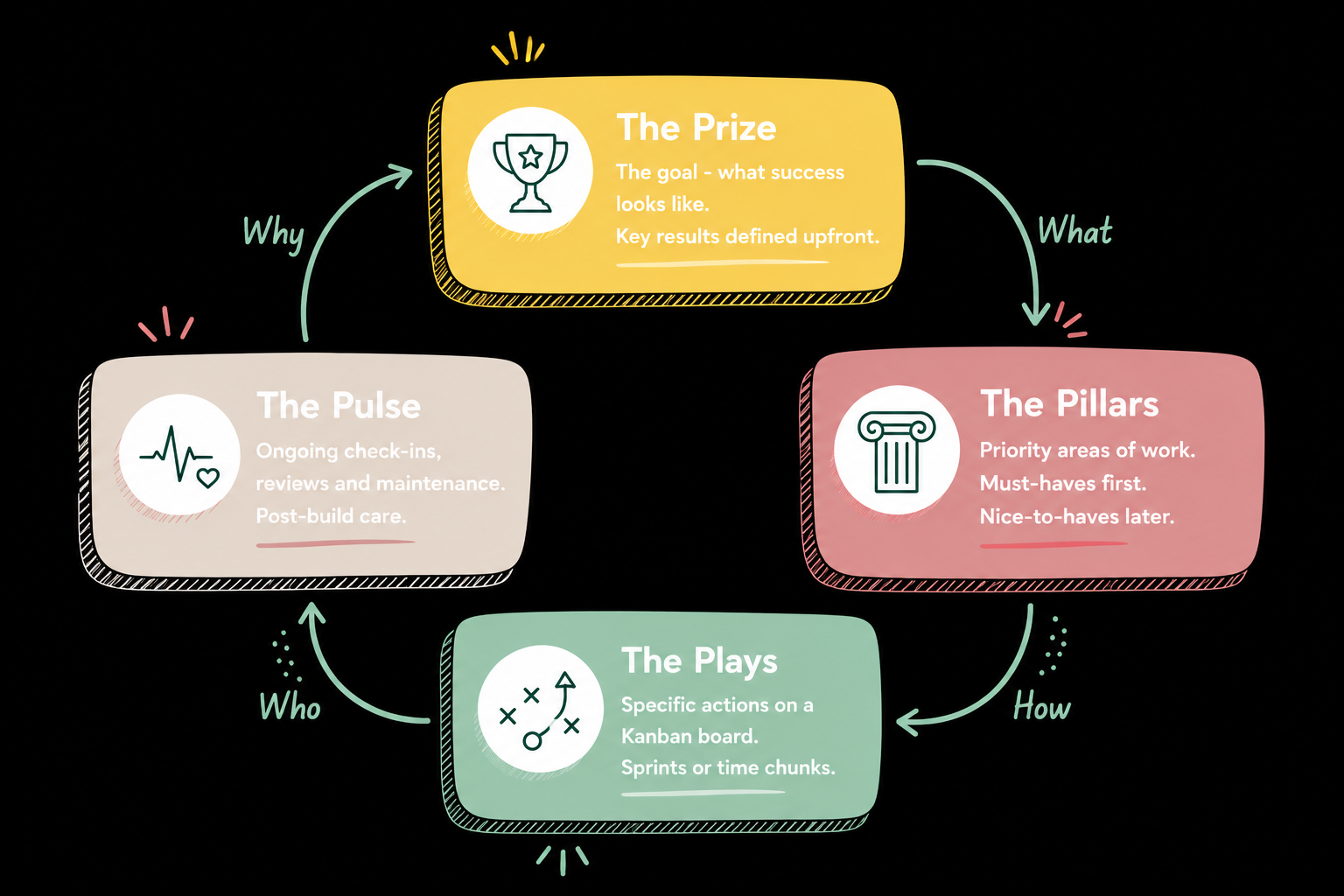
The Prize answers the why. It gives the work meaning and direction, and gets everyone aligned on what success actually looks like before anything else begins.
The Pillars address the what. What are the meaningful areas of work that need to happen? What's critical versus what can wait?
The Plays cover the how. How does the work get done? Who is doing what? What's the process, the timeline, the tool?
And The Pulse brings in the who. How is the team doing? What's working and what isn't? How do we maintain the work and keep it relevant as the business evolves?
Why simple is not the same as simplistic
I want to be clear about something: stripping a methodology back to its essentials is not the same as dumbing it down.
The Efficiency Partner Method is simple in the sense that it's accessible, jargon-free, and designed for people who don't have a project management background. But the thinking behind it is rigorous. Every element is there for a reason, drawing on frameworks that have been tested and refined over decades.
What I've tried to do is take the rigour and leave behind the complexity. Because complexity, for its own sake, is not a feature of good project management. It's usually a symptom of frameworks designed by committees for organisations with unlimited resources.
Small businesses don't have unlimited resources. What they have is a problem to solve, a goal to reach, and limited time and budget to get there. The Efficiency Partner Method is designed for that reality.
What it looks like in practice
The Prize is the goal. The single most important thing we're trying to achieve, with clear success metrics so we know when we've got there.
The Pillars are the meaningful areas of work that need to happen to reach The Prize, prioritised into what's essential, what's important and what's a nice to have.
The Plays are the specific actions that build each Pillar, tracked visually on a Kanban board and worked through in sprints or time chunks depending on what suits the client best.
The Pulse is the ongoing rhythm of check-ins, reviews and maintenance that keeps everything working after the initial build.
Together they give any engagement a clear direction, visible progress and a structure that scales to fit the complexity of the work without adding unnecessary overhead.
Is this right for your business?
If you've ever felt overwhelmed by the idea of "proper" project management, or tried to implement a methodology and found it too cumbersome to maintain, The Efficiency Partner Method might be exactly what you need.
It's designed for small businesses and purpose-led organisations that want to work in a structured, professional way without the complexity of enterprise project management frameworks. And it's delivered by someone who has spent years studying those frameworks, so you don't have to.
If you'd like to find out more about how I work, you can read about The Efficiency Partner Method in full here. Or if you're ready to have a conversation, get in touch here.
You might also find these posts useful:
Victoria Lincoln is a fractional operations partner helping small businesses, start-ups and purpose-led organisations get their systems, processes and day-to-day running properly sorted. Hands-on delivery, without the overhead of a full-time hire. Working remotely from Devon across the UK and Ireland. Find out more at The Efficiency Partner.
